

STEM Racing Advanced
One of our most exciting launches to date, STEM Racing Advanced is exclusively available to university students aged 18-21. Requiring teams to design and manufacture an electric car, it takes engineering and innovation to a whole new level.

Pilot Year
Debuting 2026/2027, STEM Racing Advanced will run as a pilot for this coming season - enabling us to learn, improve, and collaborate to create something truly special over the next 12 months before we launch to the world in 2027/2028.
Electric Vehicles
For the first time, students will be challenged to create an electric-powered car. This complex new requirement will enable teams to showcase their programming, engineering, and problem-solving skills as they design, build, and optimise.
Project management
Working in partnership with PMIEF, STEM Racing Advanced will enable university students to learn and implement industry-level project management practises, developing the skills to manage complex projects in the real world.
Developed for students aged 18–21, STEM Racing Advanced is the programme's premier competition, offering an immersive engineering experience that develops advanced skills in CAD, simulation, manufacturing, electronics, programming, systems engineering and project delivery through the design and racing of an electric Formula 1® model car.
how does It work?
A unique engineering challenge requiring HE students to test the limits of the skills.
An aero-focused competition, STEM Racing Advanced is the ultimate STEM challenge for university students, where teams design, engineer, manufacture and race high-performance electric model cars. Combining engineering, software, electronics, project management and branding, students will compete for the inaugural title of STEM Racing World Champions 2027 while developing the skills demanded by today's motorsport and technology industries.

Project Elements
Electric car
Pit display
12-page portfolio
A4 engineering drawings
A4 car renderings
15-minute verbal presentation
Equipment & Resources
To ensure consistent weight and material density across the competition, all race car bodies must be manufactured from the official STEM Racing model block. All other components may be sourced or manufactured using materials and methods of the team's choice, provided they comply with the Technical Regulations.
STEM Racing Advanced Technical Regulations: Coming soon
Competition Levels
✅ World Finals
As 2026/2027 will be the pilot season for STEM Racing Advanced, all competing universities will be entered into the World Finals. This one-day event will take place at Aston University, Birmingham, UK, in May/June 2027.
“We’re so excited to launch a class for university students. Introducing a new tier of complexity and challenge, it is the ideal engineering project for students to push their skills to the absolute limit. we can’t wait to see what they do.”
Tom Milner, Project Director, STEM Racing
entry into industry
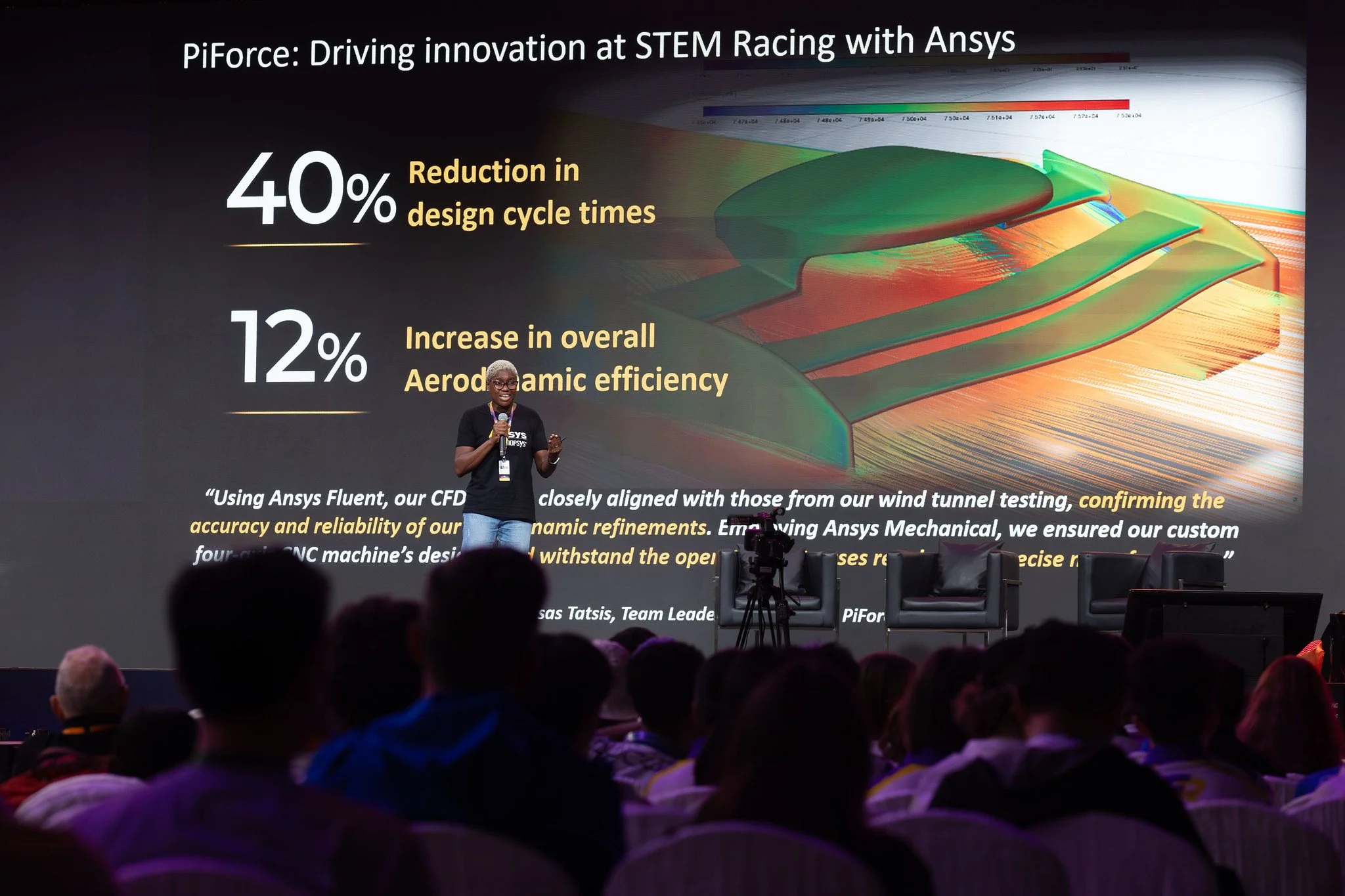
Providing an authentic engineering design experience, students take ownership of the complete product development lifecycle - from concept generation and systems architecture through to CAD design, engineering analysis, manufacture, testing and validation.
Beyond these technical skills, students also develop the professional competencies expected of graduate engineers, including collaborative problem solving, leadership, systems thinking, technical communication, design justification and evidence-based decision making. Throughout the competition they work with industry-standard digital engineering tools and manufacturing technologies while receiving feedback from engineering and industry professionals, providing valuable experience directly aligned with careers in motorsport, automotive engineering, aerospace and wider technology sectors.
Competition
Explanations & Definitions
-
C1.1 Article
Each section in all documentation will be referred to as an Article which brings STEM Racing documents in line with the Fédération Internationale de l'Automobile (FIA) documentation.
C1.2 Parc Ferme
A secure area where all race cars are held to prevent unauthorised handling but to allow technical inspections to be conducted by the Judges. (Literal meaning in French of ‘closed park’).
C1.3 Competition Schedule
The competition program will detail the schedule of judging activities for all teams.
C1.4 Key performance indicators (KPI’s)
These are portions of text that feature on the scorecards within a corresponding points range. The KPI’s describe the type of evidence the Judges are looking for in order to score the team appropriately.
C1.5 Car race time value
A ‘car race time’ value is the actual time taken for a STEM Racing™ car to travel the track from start to finish, measured from the instant the launch pod fires to when the car breaks the finish line timing beam. In the case of reaction races, the ‘car race time’ value is calculated as the ‘total race time’ value displayed on the electronic start gate minus the ‘reaction time’ value displayed for that race.
C1.6 Total race time value
The ‘total race time’ value is displayed in the total time field on the electronic start gate at the conclusion of every race. This time is the sum of the ‘car race time’ value and any ‘reaction time’ value displayed on the electronic start gate.
C1.7 Reaction time value
A ‘reaction time’ value is the time recorded from the instant the five (5) start lights extinguish to the instant the start trigger is activated by the driver. This value is displayed in the reaction time field on the start gate.
C1.8 Project elements
These are any materials and resources that the team presents as part of its entry for any judging activity.
C1.9 Engineering Drawings
Hand drawn or CAD produced drawings, which along with relevant machinery and/or CAM programs, could theoretically be used to manufacture the fully assembled car by a third party. Such drawings include all relevant dimensions, tolerances and material information. STEM Racing engineering drawings include detail to specifically identify and prove compliance for the virtual cargo and wing surfaces.
C1.10 Renderings
Renderings are images intended to illustrate the three-dimensional form of an object. These can be hand drawn or CAD generated in isometric projection, oblique projection or perspective.
-
C2.1 Competing teams
C2.1.1 Each team must consist of a minimum of 3 students to a maximum of 6, between the ages of 18+. Team members competing at the STEM Racing EV Finals must be those registered to compete on the official online registration form. If for any reason, a team member cannot travel to an event and is to be replaced by another individual, this must be brought to the attention of STEM Racing prior to the event.
C2.1.2 Only the registered team members of any official competing team (maximum 6) are permitted to wear the team’s uniform.
C2.1.3 During the competition, only the official core team members (maximum of 6) can represent the team at registration, Pit Display set up, Scrutineering review, Verbal Presentation, Design & Engineering judging, racing, on-stage presentations and any direct communication with the Chair of Judges or Event/Competition Directors.
C2.2 Team responsibilities
C2.2.1 Teams must read the EV Technical Regulations carefully to ensure their car(s) comply with those regulations.
C2.2.2 Teams must read the EV Competition Regulations (this document) carefully to ensure that all project elements satisfy these regulations and that they understand the requirements and procedures for all aspects of the competition and judging.
C2.2.3 During the competition it’s the team’s responsibility to ensure that team members are present at the correct time and location for all scheduled activities.
C2.2.4 Security of the pit display and its elements is the team’s responsibility during competition.
C2.3 Role and responsibility of supervising teacher / adult.
C2.3.1 Source of contact at the teams university, held initial registration and any other help a team may require.
C2.4 Regulations documents
C2.4.1 STEM Racing issues the regulations, their revisions and any amendments made.
C2.4.2 Competition Regulations - (this document). The Competition Regulations document is mainly concerned with regulations and procedures directly related to judging and the competition event. Competition Regulation articles have a ‘C’ prefix.
C2.4.3 Technical Regulations – a separate document which is mainly concerned with regulations that are directly related to STEM Racing™ car design and manufacture.
C2.5 Interpretation of the regulations
C2.5.1 The final text of these regulations is in English, should any dispute arise over their interpretation, the regulation text, diagrams and any related definitions should be considered together for the purpose of interpretation.
C2.5.2 Text clarification - any frequently asked questions that are deemed by STEM Racing to be related to text needing clarification will be answered. The question and the clarification will be published to all teams at the same time.
C2.6 Supplementary competition regulations
Other documents may be issued by STEM Racing that provide teams with further logistic and important event information. Any supplementary regulations will be issued to all lead teachers and team managers, where the team manager has supplied STEM Racing with a contact email address.
C2.7 Design ideas and regulation compliance queries
Teams are not permitted to seek a ruling from STEM Racing, any competition official or judge before the event as to whether a design idea complies with the regulations. Rulings will only be made by the Judges at an event. Design compliance to the regulation’s forms part of the competition. As in Formula 1, innovation is encouraged and STEM Racing teams may also find, sometimes controversial ways, of creating design features by pushing the boundaries in order to get an extra competitive edge.
C2.8 Team partnerships
C2.8.1 STEM Racing teams are encouraged to develop mentoring partnerships with businesses, industry or higher education organisations throughout their project.
C2.8.2 All design work, text and scripting for all project elements presented for assessment must be wholly undertaken and created by the team. This includes all CAD and CAM data, programming, electronic portfolio and graphic content.
C2.8.3 All aspects of any partnerships should also be represented in the team’s portfolio. For project elements produced utilising some outside assistance, teams should be able to demonstrate to the judges a high level of understanding of, and justification for, any of the processes used.
C2.8.4 ‘Common sense’ will prevail for project elements or components that a team has purchased from a supplier. E.g. bearings, screw eye, display hardware. Teams should be able to explain and justify why a specific component was selected / purchased over other similar available components.
C2.9 Mandatory project elements for the EV Finals:
The following is a summary of the mandatory elements required for judging:
Finals:
One (1) STEM Racing car including all optional replacement components
One (1) A3 or similar Design & Engineering Portfolio
A 15-minute Verbal Presentation with laptop
A Pit Display
A4 Engineering Drawings of your completed race car
A4 Renderings of your finished race car
C2.9.1 Car - each team must produce a minimum of one (1) race car
C2.9.2 Portfolios – each team must produce the following:
One (1) ‘hard copy’ 10-page maximum Design & Engineering Portfolio
Portfolios (excluding front and/or back covers) presented in an A3 (or similar) sized format for exhibition within the teams’ pit display. Refer to ARTICLE C5 & C6 of these regulations along with the Design & Engineering and Enterprise judging scorecard for portfolio specification and content requirements.
C2.9.3 Pit Display - each team will be provided with a dedicated exhibition style space for set-up of their pit display elements. The specific style and size of this space will be announced in supplementary event competition regulations. Refer to ARTICLE C8 for further pit display specifications and content requirements.
C2.9.4 Verbal Presentation - teams will be required to deliver a Verbal Presentation in relation to their project to the Judges. The presentation must not last longer than 15 minutes. Teams must bring their own laptop with any slide show or other multimedia files that need to be shown as part of their Verbal Presentation.
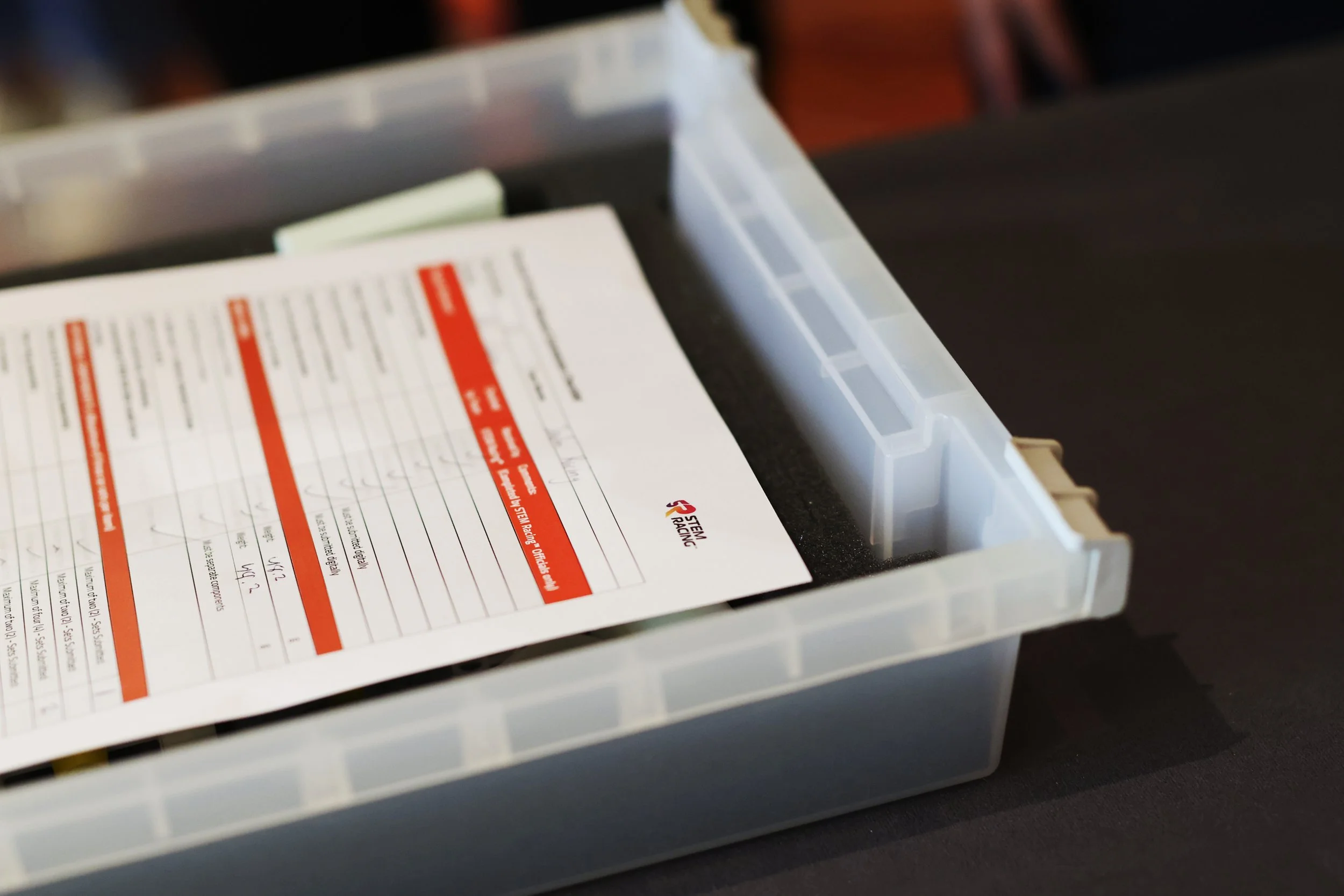
C2.9.5 Project Element Submission Checklist – teams must complete the checklist (please refer to Appendix iii) and attach their official STEM Racing Model Block holographic sticker (if applicable) for submission at the event.
C2.10 Team registration at the event
C2.10.1 Teams will be required to register with STEM Racing once arriving for the event. At this registration, teams will be issued with a detailed event welcome pack. The student team manager and supervising teacher for each team should attend.
C2.10.2 The National accreditation material issued will include the official STEM Racing 30x15mm car decals, for teams that have not manufactured their own. These decals must be fitted to each car by the team following registration and prior to the submission of their project elements.
C2.11 Submission of STEM Racing car(s)
Once a race-ready car has been submitted, they are considered as being in Parc Fermé.
A4 Engineering drawings and Renders MUST be handed into Parc Fermé with your ready to race car.
C2.12 Project elements to be retained by STEM Racing
It is a condition of the STEM Racing EV Finals entry that each team permits STEM Racing to retain 1 x race car and 1 x copy of the Design & Engineering portfolios. This can be submitted electronically if the team wishes to keep the printed version.
C2.13 Team names
No teams participating in the challenge are permitted to use any of the Formula One Word Marks (shown below) in their team name, logo, domain name, and/or any social media handle. For example, “Infinity F1” is not allowed and should be changed to something similar such as “Infinity” or “Team Infinity”. No team will be permitted to use any of the prohibited word marks within their team name when participating in STEM Racing from 2017 onwards.
The STEM RACING Logo, F1, FORMULA 1, FIA FORMULA ONE WORLD CHAMPIONSHIP, GRAND PRIX and related marks are trademarks of Formula One Licensing BV, a Formula 1 company. All rights reserved
C2.14 Benefit of doubt
The chair of judges will, where appropriate, seek to use ‘benefit of doubt’ when the assessment of compliance is marginal or unclear. In this situation, teams will be given the benefit of doubt rather than a firm penalty if a penalty cannot be clearly measured or identified.
C2.15 Spirit of the competition
Teams are expected to act in the spirit of the competition, both before and during any STEM Racing events. Any team deemed by the chair of judges to be acting outside of the spirit of the competition, can be removed from certain or all aspects of the competition. For example, a team attempting to exploit the technical regulations to their advantage may, at the discretion of the chair of judges, be removed from racing and receive no points for this activity.
The spirit of the competition is simple; embrace and respect the rules and regulations, do your very best to compete legally and fairly, while contributing positively to STEM Racing. Make friends, create positive relationships, network professionally and enjoy yourselves.
-
C3.1 Competition program
C3.1.1 Each team will be judged as per the competition program. The competition program will be formulated by STEM Racing to best and fairly accommodate all judging and other competition activities. Teams will rotate around judging activities as per this program, with each rotation usually of 15 minutes in duration.
C3.1.2 Judging Streams – the competition program will normally be divided into two parallel judging streams (Stream A and Stream B), to help ensure quality judging time intervals within the event time constraints. A number of strategies are implemented within the judging process, including judge briefings and judge reviews for cross-moderation to ensure there is consistency across the judging streams.
C3.2 Judging categories
There are six (6) main judging categories, each with its own team of judges and specified judging activities as detailed in further articles.
Specification and Scrutineering Judging
Design and Engineering Judging
Verbal Presentation Judging
Brand Identity Judging
Racing
C3.3 Judging scorecards
The STEM Racing judging scorecards provide detailed information in relation to what the Judges will be looking for. They include key performance indicators which are referred to by the judges in awarding points during judging activities. The judging scorecards can be found from p24 of this document, alongside guidance for the corresponding judging category. Reading the scorecards carefully is important. They provide critical information for teams as to what needs to be presented for each judging category.
The judging scorecards are not to be viewed as assessment criteria but are for the purpose of ranking teams at STEM Racing events. Marks given may differ between events, so scores should not be used exclusively to determine the strengths and weaknesses of a team.
C3.4 World Champions
The STEM Racing EV International Champions trophy will be awarded to the team with the highest total score, sum of all judging categories (ARTICLE C3.5). In the case of a tied points score, the team with the highest racing score will be determined the winner.
Specification and Scrutineering Judging (170 points)
Specifications - 110 points
Engineering Drawings - 20 points
Renderings - 20 points
Quality of Finish and Assembly - 20 points
Design and Engineering Judging (200 points)
Design & Engineering Portfolio - 200 points
Brand Identity Judging (140 points)
Corporate Identity - 60 points
Pit Display - 80 points
Verbal Presentation Judging (180 points)
Technique - 60 points
Composition - 40 points
Project Management - 80 points
Racing (220 points)
Time Trials - 110 points
Reaction Racing - 110 points
TOTAL: 910 points
C3.6 Classification of Technical Regulations
C3.6.1 The technical regulations are classified as either: GENERAL, SAFETY, PERFORMANCE. Please refer to the Technical Regulations for more information on compliance and penalties.
GENERAL: Regulations that shape the way the car fundamentally looks and works, vital to the style of an STEM Racing car.
SAFETY: Mandatory rules that govern the safe running of the car. Cars must meet these rules to be considered ‘safe to race’.
PERFORMANCE: Rules that have a direct impact on the performance of the vehicle, these typically carry the heaviest penalties.
P3.6.2 If a race car is judged as being NON-COMPLIANT with any Performance Regulation they will be INELIGIBLE for the awards of: ‘Fastest Car’ and ‘Best Engineered Car’. All Performance regulations are highlighted in yellow throughout the Technical Regulations document for each class.
Judging
Assessment Criteria
-
C4.1 What will be judged?
Scrutineering judging is a detailed inspection process where all race cars plus any optional replacement components are assessed for compliance with the STEM Racing Technical Regulations. The A4 Engineering Drawings, A4 Renderings and quality of finish & assembly will also be assessed. Refer to the scrutineering and specification judging scorecards for scoring details.
C4.2 Team preparation
Teams must ensure that their car(s), A4 engineering drawings, A4 renders and any optional replacement components are complete and ready for specification judging and racing before they are submitted. At the Finals, teams must also submit an electronic copy of all specified project data such as scrutineering engineering drawings, which may all be referenced. For more information, refer to ARTICLE C2.9 and C3.6.
C4.3 Who needs to attend?
Specification & Scrutineering judging is a closed activity that no team member or supervising teacher may attend. At the Finals, for selected teams there will be a specification review session scheduled that must be attended by the team manager, team design and manufacturing engineers as a minimum.
C4.4 Judging process / procedure
Teams begin specification judging with a full allocation of 110 points. Any infringements of the Technical Regulation articles, on either car, will result in points being deducted as detailed in the Technical Regulations.
There are two (2) parts to the specification judging process.
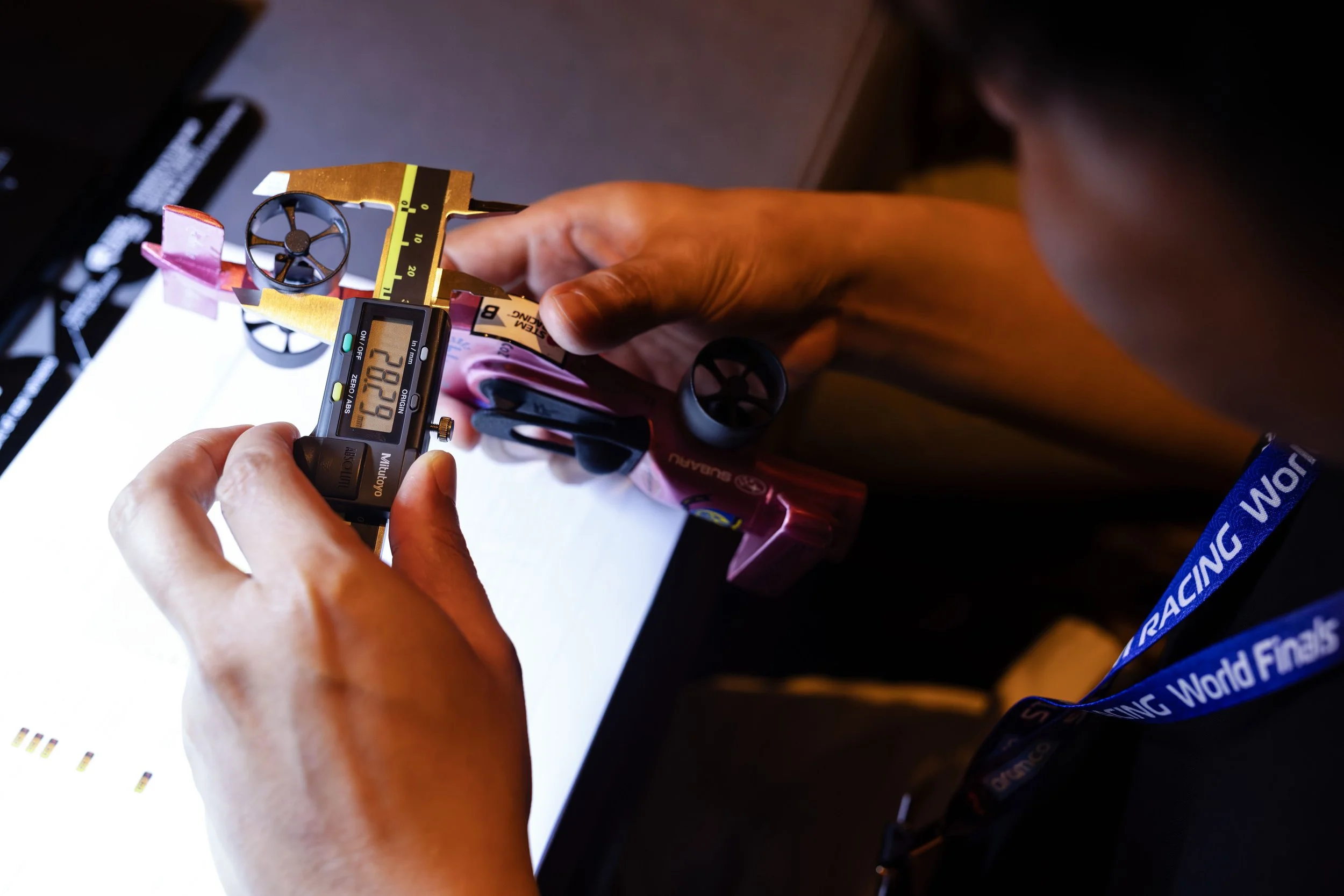
Specifications – this is conducted within the confines of Parc Fermé, where the specification Judges will scrutineer all cars submitted and optional replacement components for compliance to the Technical Regulations. A series of specially manufactured gauges will be used to broadly check compliance. Accurate measuring tools, such as Vernier callipers will then be used to closely inspect any dimensions found to be near to dimensional limits per the initial gauge inspection. Scrutineering commences immediately, as soon as cars, engineering drawings, renders and optional replacement components are submitted.
A4 Engineering Drawings & Renderings – these documents are used along with the car(s) to assess Engineering Drawings, Rendering and Quality of Finish & Assembly as on the Scrutineering Judging scorecard - this is conducted within the confines of Parc Fermé, where the specification Judges will assess both cars as per the Scrutineering scorecard.
C4.5 Safe/Fit to race fix
At the EV Finals, a special 20-minute car service time will commence prior to the start of racing, for any teams judged during initial scrutineering to have incurred a regulation failure from the list below. Cars must meet these rules to be considered ‘Safe/Fit to race. If during this service time the car can be modified to comply with the failed regulation(s), the team will then only incur half the penalty points for that infringement, without being classified as having incurred a SAFETY infringement.
-
C5.1 What will be judged?
The Design & Engineering judges will mark your 10-page Design & Engineering Portfolio so that they can assess the team’s car design and use of CAD/CAM technologies along with the quality of manufacture of all race cars submitted.
C5.2 Team preparation
A laptop needs to be ready and taken to Design & Engineering judging along with any other items which may help the team explain any Engineering or manufacturing concepts. The Design & Engineering judges will have access to the car(s) submitted for racing but will not have access to the team pit display for judging purposes. Preparation should include careful reading of the scorecard. The key performance indicators for the design process, application of CAD / CAM, analysis and associated data organisation, describe what the judges will be looking for.
C5.3 Who needs to attend?
This judging session must be attended by the team manager and team design and manufacturing engineers as a minimum.
C5.4 Judging process / procedure
Teams will be awarded points as per the key performance indicators shown on the Design & Engineering scorecard. Judges will review the Design & Engineering portfolio in a ‘closed to teams’ session programmed before the commencement of scheduled judging sessions. The scheduled Design & Engineering judging interview session will focus on the overall Engineering and Design of the car. This is an informal interview where Judges will ask the team to demonstrate their CAD / CAM work and query teams on what they have done. The quality of car manufacture and car assembly will be judged during a separate ‘closed to teams’ session. Please note: The Best Engineered Car award takes into account any penalties occurred through damage during racing (please refer to C10.1.3 for more details).
C5.5 Design & Engineering Portfolio requirements
The Design & Engineering portfolio must be in a printed ‘hard copy’ format or saved as a PDF of A3 or similar size. Teams must also provide an electronic copy of their Enterprise and Design and Engineering portfolios to STEM Racing. Submission details will be provided to teams prior to the event.
The portfolio is limited to 10 pages of content, which does not include the front and back covers. This can be 10 single sided or 5 double sided sheets. If a portfolio comprises more than 10 pages, the Judges will only assess the first 10 PRINTED pages after the front cover.
There MUST be content related to the use of CAM and CNC manufacturing included in the portfolio and this will be referenced by the Engineering Judges. An orthographic drawing and 3D render must also be included in the portfolio, refer ARTICLE C2.10. Content related to the car, design ideas, design development, research, testing and evaluation are commonly presented within the portfolio.
Please note: Front and back covers do not contribute towards the portfolio assessment in any way, these are purely presentation items.
-
C6.1 What will be judged?
Presentation technique (how your team comes across during the presentation)
Presentation composition (how well you structure your presentation)
Subject Matter (the topics which need to be talked about)
C6.2 Team preparation
Each team is required to prepare a 15-minute Verbal Presentation as per the requirements at ARTICLE C2.9.4. Any multimedia content, slides etc. must be saved on and shown, using the team’s own laptop. Teams must have all presentation resources tested and ready with them for Verbal Presentation judging. Most importantly, teams should read the Verbal Presentation judging scorecard carefully to ensure their verbal presentation features all elements and content that the judges will be looking for.
C6.3 Who needs to attend?
All team members must be present during the Verbal Presentation judging session.
C6.4 Judging process / procedure
Verbal Presentation judging is scheduled for the same duration of other judging sessions, usually 20 minutes. Teams will be given an opportunity at the start of their time to set-up and test their laptop and any other presentation technologies and resources. The team will inform the judges when they are ready to begin. The judges start timing the15-minute duration and will provide a discreet time warning signal when one minute of presentation time remains. The team will be asked to cease presenting when the time limit has been reached. At the conclusion of the team’s presentation time, the judges may choose to provide some feedback and / or ask any clarifying questions they feel necessary.
C6.5 Verbal presentation judging provisions
STEM Racing will provide a dedicated private space, such as a small meeting room, where each team will deliver their presentation to the judges. This space will include a data projector, screen and multimedia sound system. These will be in fixed positions but usually with sufficient cable length to allow teams some freedom for choosing where they wish to locate their laptop. A single table will also be made available with its use and location in the presentation space being optional.
C6.6 Verbal presentation video recordings
The Verbal Presentations of all teams may be video recorded by STEM Racing for the purpose of judging review and/or post event publicity and promotional purposes by STEM Racing™.
C6.7 Project Management Guidebook
As mentioned previously in this document, STEM Racing has produced a guidebook in partnership with Project Management Institute Educational Foundation (PMIEF), to help equip teams with industry-level terminology and techniques to employ in their project work. Using the correct terminology is important, but just as crucial is understanding the meaning of these phrases and words. Teams are advised to learn the basics of professional Project Management through the guide, to increase their chances of successfully achieving the higher KPI’s in the Enterprise scorecard. Using the guide is not mandatory, nor is it a comprehensive guide to all the activities your teams may undertake, but we have created a document that can add to your teams understanding of much of the Project Management work they already do, while giving a few ideas to help them improve further. STEM Racing would like to acknowledge the detailed and professional work of PMIEF in helping us create this document. The STEM Racing Project Management Guidebook can be downloaded directly from: https://www.stemracing.co.uk/resources.
-
C7.1 What will be judged?
The Brand Identity judges will assess each teams’ Pit Display and overall Corporate Identity, through all project elements.
C7.2 Team Preparation
Each team must prepare a Pit Display as per ARTICLE C2.9. Most importantly, teams need to read the Brand Identity judging scorecard carefully to ensure that all areas to be assessed are included within the design of their Pit Display and/or additional competition project elements. The judges will assess each teams’ Corporate identity through the Pit Display and all other project elements, so it’s important to have a continuous theme throughout all your work.
C7.3 Who needs to attend?
All team members must be present during the Pit Display judging session.
C7.4 Judging process / procedure
The Brand Identity judging will take place at each teams Pit Display. The Judges will usually introduce themselves then ask the team to stand clear of their display so the Judges can conduct assessments, while asking further questions about the work. Outside judging slots, the Judges will also be given some time to conduct pre-judging and review of each team’s Pit Display and other competition elements, in order to accurately assess Corporate Identity.
C7.5 Pit Display setup and parameters
C7.5.1 At Regional Finals, teams will be given a classroom style table (no bigger than 2m x 1m) to present their pit display. At the EV Finals, STEM Racing will provide each team with an exhibition style display booth approximately 2m wide x 1m deep.
C7.5.2 At the EV Finals, no part of the teams completed Pit Display is allowed to protrude beyond the physical dimensions of their allocated pit space. This includes anything that might protrude above the pit space highest point e.g. flags.
C7.5.3 ONLY student team members are permitted to set-up their pit displays. There must be no supervising teacher / adult or other outside assistance, unless deemed by STEM Racing to be a health and safety issue.
IMPORTANT HEALTH & SAFETY: Please ensure that Health and Safety measures are considered when working on all aspects of your Pit Display. STEM Racing reserves the right to apply a penalty of up to 50 points at the discretion of the Chair of Judges for unsafe activity.
C7.5.5 STEM Racing and / or the Chair of Judges may instruct a team to take action to reduce noise or remove display inclusions deemed to be inappropriate. STEM Racing will instruct teams to remove or alter any display inclusions considered to be a safety hazard.
C7.5.6 Any electrical appliance connected to the power supply must be PAT tested and approved. Please note, at Regional Finals there may be no availability of power for teams, so it is advisable not to rely on this assumption for your display.
racing
How It Works
-
C8.1 What races will be conducted?
STEM Racing points will be awarded through the staging of one (1) type of race event:
Reaction Racing – manual / driver launch mode, two races in each lane.
Reaction racing will be split over one (1) sessions of four races. The average 'car race time' value from all reaction races will determine the Fastest Car Award (refer to C8.6). Refer to ARTICLE C3.5 and further information following for details on how points are calculated and awarded.
Please note: at the EV Finals, 1 car will be required to race. Refer to ARTICLE C3.5 and further information following for details on how points are calculated and awarded.
C8.2 Team preparation
C8.2.1 Teams should be familiar with the operation of the STEM Racing Race System. There will normally be a section demonstration track within the venue where teams can practice race starts during free time prior to their scheduled races.
C8.2.2 Manual / driver starts - one or more team members (driver/s) must be appointed for launching of the teams’ car using the manual launch method. The driver must stand within the dedicated starting area.
C8.2.3 Finish line management - at least one member of the team must be appointed as responsible for managing the finish line deceleration system or teams’ own system (refer C8.10.2) and return of car along the track to the start.
C8.2.4 Start line car staging – one team member may be appointed as being responsible for ‘aligning’ the car. This team member is only permitted to set the alignment of the car behind the start line, with respect to the launch pod and track under close supervision from the racetrack Judges. This process must be completed within a time limit of 30 seconds. Appointment of this team member is optional. All four wheels must be in contact with the track surface after completion of the car staging time. The race Judges can assist or perform this task for the team.
C8.2.5 Teams must ensure that their car is race ready, a car service session will be provided before the next race event (refer C10.2). If a teams’ car is damaged beyond achievable repair, then teams will forfeit any races that the car would have been used for.
All team members must be present during their scheduled racing sessions and should assemble at the track start for briefing by the racetrack judges at their scheduled time.
C8.4 Reaction race procedure
Cars are launched in manual (driver launched) mode with four (4) races total per team, two (2) races in each lane. The TOTAL RACE TIME displayed, and the REACTION TIME displayed for each race is recorded. The reaction races will be conducted as follows:
Teams race in order as shown in the competition program. To begin racing, the lowest team number will start in lane 1. All cars will be loaded onto the track, Car A first then Car B
One team member to track finish for deceleration system control
Judge arms launch pod - SAFETY ON – makes initial launch pod adjustments
Race 1 (Car A) - Judge sets cars on track / tether line
A team member is then allowed 30 seconds to ‘fine tune’ the alignment of their car, please see C8.2.4 for more detail
Driver and team stand trackside with corresponding lane start trigger
Judge checks deceleration system is ready, track is clear for racing, switches launch pod - SAFETY OFF
Judge presses the start system reset button – cars are launched by driver pressing start trigger
Judge records TOTAL RACE TIME and REACTION TIME displayed on start gate
Team member at finish moves car into storage zone at the end of the track
Race 2 (Car B) conducted in same lane as above, driver can be inter-changed as nominated
Team member at finish control returns car to the start with minimum handling
Judges remove cars from tether line and change lanes
Race 3 (Car A) and Race 4 (Car B), driver can be inter-changed as nominated
Cars removed from track and returned to Parc Fermé
C8.5 Reaction race scoring
All four (4) ‘total race times’ recorded from the reaction races are considered. The fastest of these four (4) times is used in the following formulae to calculate the points awarded:
Fastest ‘total race time’ = 110 pts
2nd fastest ‘total race time’ = 105 pts
3rd fastest ‘total race time’ = 100 pts
Slowest ‘total race time’ = 5 pts
Base Time = 120% of 3rd fastest ‘total race time’
4th fastest and all other teams score points using the following formula:
Team Points = 5 + (95 / (Base Time – fastest ‘total race time’)) x (Base Time – teams fastest ‘total race time’)
Any team with a best ‘total race time’ that is slower than the base time will score 5 points. To further discriminate between any teams scoring 5 points, a deduction of 1 point will be made for any did not finish (DNF) reaction race result
C8.6 Time Trial race scoring
The four (4) ‘car race times’ recorded during the reaction races will be considered. From these four (4) races, the team’s 2nd and 3rd best ‘car race times’ will be averaged. This average time is used in the following formulae to calculate the points awarded:
Fastest average (avg.) time = 110 pts
Second fastest avg. time = 105 pts
Third fastest avg. time = 100 pts.
‘Base Time’ = 115% of the third fastest avg. time of all teams avg. times.
Fourth (4th) to slowest avg. time score points using the following formula:
Team Points = 20 + (80/(Base Time – 3rd fastest avg.)) x (Base Time – teams avg.)
Any team that has an average slower than the base time will score 20 points. To further discriminate between these teams, a deduction will be made of 5 points for any did not finish (DNF) time trial result
If after discarding a team’s fastest time there remains less than two (2) times from races finished, due to DNFs, the slowest time recorded is again input to the average equation until there are a total of four (4) times to average
C8.7 DNF (Did not Finish) race results
Damage or part separation occurring during a race, before the car crosses the finish line, (e.g. wheel or any other part of the car separating), or car not crossing the finish line at all, effects in a DNF race result. The Judges may refer to video evidence to verify a DNF result.
C8.8 False starts
C8.8.1 A false start (jump start) occurs when the driver presses the trigger button before the five (5) start gate lights have extinguished. This will be signalled with the outer red light above the lanes illuminating.
C8.8.2 All reaction false starts will incur a 2.5-point penalty and by default, forfeit that race. This penalty does not apply to knock-out racing.
C8.8.3 During knock-out racing – if one team false starts (jump starts), the other team should continue to race as normal. The team who false started forfeits that race, scoring a DNF and the other team’s time is recorded. If both teams false start, the race counts as one of the two (2) runs.
C8.8.4 During any manual / driver starts, if a driver false starts and distracts the other driver the race will be re-run and thedriver who caused the distraction will forfeit their race.
C8.8.5 Distractions outside of the race start area will be assessed by the lead track judge and track officials to determine if the race should be re-run. Spectators must keep noise down to a minimum and not use flash photography.
C8.9 Track, tether line and timing system information
C8.9.1 The STEM Racing Elevated Racetrack, supplied by Denford Ltd will be used. The official length of the track, from start line to finish is 20 metres. A monofilament tether line of diameter 0.6mm, fixed at the finish end, passes down the centre of each lane. At the start end the line passes through 90 degrees over a single pulley then attached to a 1.0kg mass suspended above the floor.
IMPORTANT: Teams are not permitted to add anything to the racetrack until 250mm after the finish line/gate.
C8.9.2 Launch/Timing - The STEM Racing Launch/Timing System will be used for launching cars and timing races and driver reaction times to 1/1000th of a second.
C8.10 Car Deceleration system
C8.10.1 The Car Deceleration System acts to bring cars to rest once crossing the finish line. STEM Racing will provide a standard Car Deceleration System, consisting of tapered brushes positioned behind the finish line of each lane.
C8.10.2 Teams may supply their own deceleration system and the team will be responsible for its management. Any system supplied by a team must be simple to setup within 1 minute and must not impede the opposing track lane, race car or the race schedule in any way. The judges, at their discretion, can rule any system supplied by a team to be inappropriate and revert to use of the standard deceleration system.
C8.10.3 Deceleration systems must be located a minimum of 250mm after the finish line.
C8.12 Car weight checks
Cars will have their weight checked at the racetrack prior to commencing a race event. This is done to ensure each car remains at a legal weight during all races. If a car is judged to have gone under weight whilst stored in Parc Fermé, the judges will add ballast to return the car weight to what it was when first submitted to Parc Fermé, without penalty.
C8.13 Judges handling cars
The race Judges will not be required to comply with any special car handling requests made of them by teams. This includes use of any special gloves or tools.
At the EV Finals, a special 20-minute car service time will commence prior to the start of racing, for any teams judged during initial scrutineering to have incurred a regulation failure from the list below. Cars must meet these rules to be considered ‘Safe/Fit to race. If during this service time the car can be modified to comply with the failed regulation(s), the team will then only incur half the penalty points for that infringement, without being classified as having incurred a SAFETY infringement.
details
Key Information
-
C9.1 Car repairs
C9.1.1 All damage issues and related repair work during racing is at the Judge’s discretion and may be referred to the scrutineering Judges and/or Chair of Judges for a final decision.
C9.1.2 No items can be removed or added to a car during racing, except in the case of a repair.
C9.1.3 If any race car sustains damage during racing and this damage is ruled to be related to engineering deficiencies, the damage can be repaired using any of the defined replacement components. Any repairs using replacement components that can be safely performed in under 30 seconds will not incur any race penalty points. A timer will start when the race official places the damaged car on the official repair table. If the repair takes longer than 30 seconds, doesn’t use the defined replacement components or the car is not race ready, then a 5-point penalty will be applied. A repair time limit of 120 seconds (2 minutes) will be applied, if the car is not race ready at the end of this time then any further repairs must take place in the next service session This may include but not be limited to car body, wings & wheels being damaged as part of racing including damage occurring within the deceleration area. Please note: The Best Engineered Car award is calculated using several scores from the competition, including penalty points incurred through damage during racing. Please see the Awards Matrix in the appendix of this document for more information.
C9.1.4 Engineering deficiencies may include but not limited to damage to car body, wings & wheels as part of racing including damage occurring within the deceleration area.
C9.1.5 Curing time for adhesives must be included in 30 second repairs.
C9.1.6 Tool kits are allowed to be taken racing. Teams must supply all of their own tools and other necessary resources. Judges will not be able to assist teams with any additional resource requirements
C9.1.7 If the Judges rule that damaged sustained was not due to engineering deficiencies, immediate repairs will be permitted without penalty.
C9.1.8 No penalty is applied for damage incurred during knock-out racing or a car’s final race of any race event.
-
C10.1 Submitting a protest
Any protest issues must be submitted by the team manager to an Event Director, no more than 10 minutes after the conclusion of the final scheduled race event. This will be registered and immediately lodged with the Chair of Judges. Any protest or appeals submitted after this time may be disregarded. All protests must be lodged in writing via the official protest form available from the Event Directors. The Chair of Judges decision related to any protest is final.
C10.2 Unsuccessful protests
Teams should carefully consider their grounds for submitting a protest or appeal. Any protest or appeal that is unsuccessful, with the Judges initial decision remaining unchanged, will result in the team having a 15-point penalty applied against their total score
-
At Regional Finals, there will be a minimum of five (5) teams of judges plus officials that form the entire judging panel. At the EV Finals this increases to a minimum of 11 (eleven) teams of judges to allow for the greater number of teams. Each judging team will have one (1) judge appointed as the Stream Lead Judge. Judges are education and industry experts invited by STEM Racing. All judges sign a ‘declaration’ to ensure there are no conflicts of interest with respect to judges and the teams they are judging.
C11.2 Chair of Judges
This is an independent authority appointed by STEM Racing who oversees all judging procedures. The Chair of Judges will determine the final judging decision where a protest has been submitted or other judging issue needs resolution. The Chair of Judges will also preside over a meeting of all Lead Judges to ratify the final results along with nominations and winners for relevant awards. At Regional Finals, STEM Racing will nominate one lead official to act as Chair of Judges for any resolutions.
C11.3 The Judging teams
C11.3.1 Specification and Scrutineering Judges - will assess all race cars as per the Specification and Scrutineering scorecards.
C11.3.2 Design and Engineering Judges - will assess each team as per the Design & Engineering scorecard.
C11.3.3 Verbal Presentation Judges – will assess each team as per the Verbal Presentation scorecard.
C11.3.5 Race Judges – will oversee and rule on all race events and any incidents.
C11.3.6 Car servicing officials – will oversee all car service activities and rule on any infringements that may occur.
C11.3.7 Brand Identity Judges – will assess each team’s use of marketing and social media.
C11.4 Judging Decisions
THE DECISION OF THE JUDGES AND OFFICIALS IS FINAL.
-
C12.1 Awards Celebration
Awards will be presented at the Awards Ceremony at the end of the competition.
C12.2 Participation Recognition
All students will receive an official participation certificate from STEM Racing.
C12.3 List of awards to be presented
A full list of awards to be presented will be announced before the event. All awards will be presented to the team that achieves the highest score in each category taken from the scorecards unless otherwise stated below.
Achievement Awards:
1st Place
2nd Place
3rd Place
Best Engineered Car
Fastest Car
Scorecards
Download the official judging scorecards for every competition category to understand exactly what the judges are looking for. Each scorecard outlines the assessment criteria and explains the expectations for the Low, Middle, and High performance bands, helping your team identify strengths, areas for improvement, and what is required to achieve top marks.
Scrutineering Scorecard
Understand how your engineering drawings, CAD renderings, and car quality will be assessed by our panel of expert judges.
Verbal Presentation Scorecard
Understand how your engineering drawings, CAD renderings, and car quality will be assessed by our panel of expert judges.
Specifications Scorecard
Review each technical requirement and potential penalties to ensure your car is compliant, and avoid unnecessary deductions before race day.
Scoring Matrix
Illustrating which judging categories contribute to which award, this matrix helps your team maximise your chances of success.
Page Version: V1
First Published: 23 July 2026
Last Updated: 23 July 2026
Design & Engineering Scorecard
Learn how your portfolio will be assessed, from design concepts and CAD modelling to testing, manufacturing and programming.

Brand Identity Scorecard
Identify how your team will be assessed across everything from sponsorships to the sustainability of your pit display.
Project Management Handbook
Developed in conjunction with PMIEF, this handbook helps teams apply essential Project Management skills throughout their journey.
Registration
To be part of the inaugural STEM Racing Advanced competition, please complete the short form below.
JOIN THE RACE